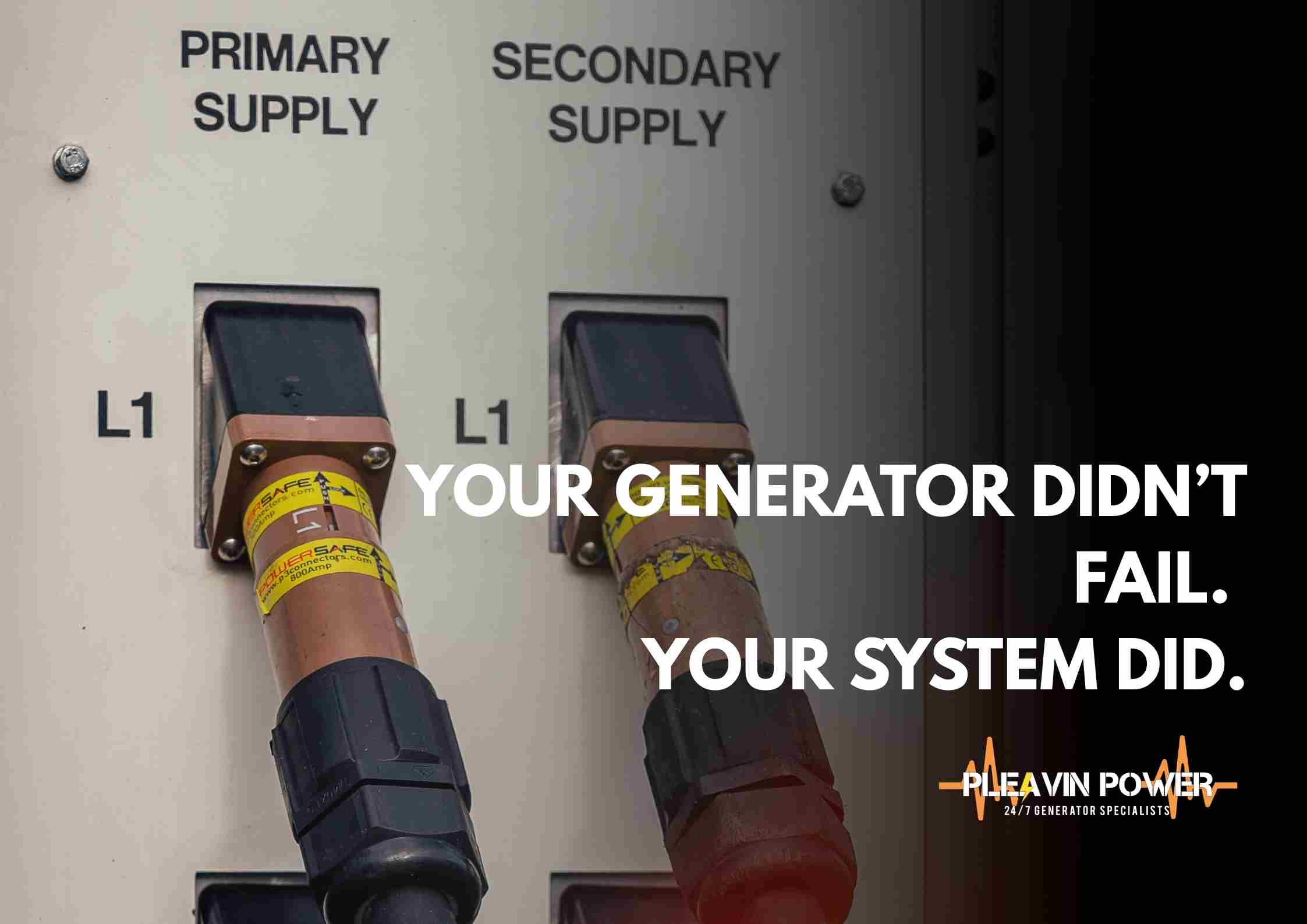
When large businesses talk about emergency power, the word “reliability” is almost always front and centre. It appears in specifications, board presentations, procurement documents, and marketing materials. Yet despite how often it is used, reliability is one of the most misunderstood concepts in backup power.
In practice, many organisations treat reliability as an assumption rather than a discipline. If a generator is installed, tested, and signed off, it is considered reliable (until the moment it is needed most). At Pleavin Power, we see time and again that real-world outages rarely fail because of a single obvious fault. They fail because systems behave differently under stress than they do on paper.
For businesses whose operations, safety, or reputation depend on uninterrupted power, it is worth taking a closer look at what reliability really means.
Defining Reliability in Emergency Power
In operational terms, reliability is the ability of an emergency power system to deliver the required electrical load, at the required time, for the required duration, under real outage conditions.
That definition is deliberately practical. Reliability is not about theoretical capability or nameplate ratings; it is about predictable performance when conditions are least forgiving. This is why experienced power specialists focus on outcomes, not just specifications.
Reliability is also frequently confused with the following related concepts:
Each plays a role, but none guarantees reliability on its own. A reliable system is one that performs successfully during an actual power event – not just during inspection or routine testing.
Reliability Is a System
One of the most common misconceptions in emergency power planning is equating reliability with the generator itself. In reality, the generator is only one part of a much larger system.
True reliability depends on the coordinated operation of:
- Utility supply monitoring and failure detection
- Automatic Transfer Switches (ATS) and switchgear
- Control systems and communications
- Starting batteries and auxiliary power
- Fuel storage, quality, and supply logistics
- Cooling, ventilation, and exhaust systems
- Load characteristics and prioritisation.
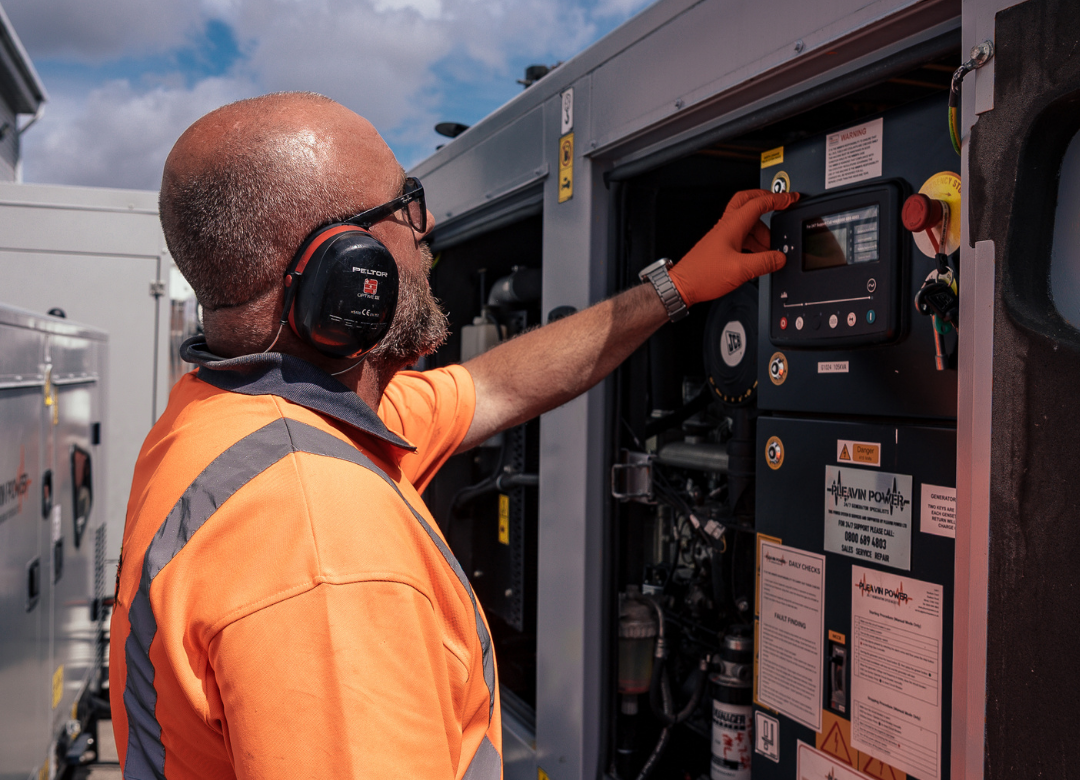
In many failures investigated by experienced power engineers, the generator performs exactly as designed. The failure occurs elsewhere: a transfer sequence is interrupted, a control signal is delayed, a fuel system component is compromised, or a battery that tested acceptably does not perform under real load.
Reliability is limited not by the strongest component, but by the weakest interaction within the system.
The Common Myths About “Reliable” Emergency Power
Many reliability issues stem from assumptions that are rarely challenged until a failure occurs.
“If it passes its tests, it’s reliable.”
Routine testing is essential, but most test regimes are limited in scope. Grid failures often involve unstable voltage, sudden load changes, extended runtimes, or environmental conditions that testing does not fully replicate. Systems that perform perfectly in tests can still struggle in real outages.
“N+1 redundancy guarantees reliability.”
Redundancy reduces certain risks but introduces others. Additional generators, transfer switches, and control layers increase complexity. Without careful integration and clear operating logic, redundancy can actually increase the number of potential failure paths.
“New equipment is more reliable than old.”
Modern systems offer improved monitoring and efficiency, but reliability is just as dependent on correct commissioning, configuration, and maintenance. Well-managed legacy systems often outperform newer installations that are poorly understood.
“Oversizing makes systems safer.”
Oversized generators can operate inefficiently, leading to issues such as wet stacking, poor load response, and long-term reliability degradation.
Talk to our team about real-world reliability.
Maintenance, Testing, and the Human Factor
Emergency power reliability is sustained – or undermined – long after installation.
Maintenance quality is far more important than maintenance frequency. Effective maintenance identifies trends, not just faults, and focuses on components and interfaces that historically cause failure.
Testing plays a critical role, but only when it reflects real operating conditions. Load testing, extended runtime tests, and scenario-based testing provide insights that routine no-load starts cannot. Just as importantly, test results must be reviewed by people who understand system behaviour, not simply logged for compliance.
Reliable systems are those that are understood by the people responsible for them.
How Reliability is Measured
From an operational perspective, reliability is demonstrated during events, not inspections.
Meaningful indicators include:
- Failure to Start (FTS) – did the generator start when required?
- Failure to Transfer (FTT) – did the load transfer correctly and on time?
- Runtime performance – did the system sustain power for the required duration?
- Event success rate – did the system perform as intended during real outages?
Standards, certifications, and inspections provide important assurance, but they are indicators of preparedness, not proof of reliability.
Designing for Real Reliability
For large businesses, reliable emergency power is rarely achieved through specification alone. It is the result of design choices that reflect how systems behave in real operating environments. The following principles consistently underpin systems that perform when they are needed most.
Prioritising Simplicity Where Possible
Complexity is one of the most underestimated risks in emergency power systems. Each additional component, control layer, or operating mode introduces new interactions and new failure paths. While redundancy and automation are often necessary, they must be applied deliberately.
Simpler systems are easier to understand, test, and maintain. They reduce the likelihood of configuration errors and make fault conditions easier to diagnose under pressure. In practice, a well-designed, clearly defined system will often outperform a more elaborate solution that relies on perfect sequencing or operator intervention to function correctly.
Ensuring Failure Modes Are Predictable and Recoverable
No system is immune to failure. Reliable systems are not those that never fail, but those that fail in controlled, predictable ways.
Designing for predictable failure means understanding what happens when a component does not respond as expected, and ensuring the system transitions to a safe, recoverable state. This might involve clear isolation points, default transfer positions, or straightforward manual override procedures.
When failure modes are well understood, recovery is faster and less risky. This is especially important during extended outages, where systems may need to be reconfigured or supported under time pressure.
Testing Systems Under Realistic Conditions
Routine testing is essential, but it often focuses on individual components rather than system behaviour. Starting a generator with no load, for example, provides limited insight into how the system will perform during a real outage.
More meaningful testing replicates real conditions as closely as possible: load acceptance, load rejection, extended runtimes, fuel usage, and transfer sequencing. Scenario-based testing (such as simulating partial failures or staged load restoration) can reveal weaknesses that standard tests overlook.
Realistic testing builds confidence not only in the equipment, but in the system as a whole.
Aligning System Design with how the Site is Actually Operated
Emergency power systems do not operate in isolation. They depend on people, procedures, and site conditions.
A system designed for constant on-site technical staff may be unsuitable for a facility that is lightly staffed or remotely managed. Similarly, complex manual intervention steps increase risk if they are required during high-stress events.
Reliable design reflects operational reality: who will be present during an outage, what decisions they are expected to make, and how clearly those decisions are supported by the system itself.
Designing for Maintainability Over the Full System Lifecycle
Reliability is sustained over years, not achieved at commissioning.
Systems that are easy to inspect, access, and service are more likely to be maintained correctly. Clear layouts, sensible component placement, and good documentation reduce the risk of maintenance-related errors and make issues easier to identify early.
Designing for maintainability also means planning for future change – whether that involves load growth, regulatory updates, or equipment replacement. Systems that can adapt without extensive rework are far more likely to remain reliable over their full lifecycle.
Reliability Is Earned, Not Claimed
In emergency power systems, reliability is not something that can be specified into existence or confirmed at handover. It is the result of informed design, careful integration, disciplined maintenance, and ongoing operational awareness.
For organisations that depend on operational generator systems, the most important question is not “Is our system reliable?” but “Do we understand how it could fail, and have we taken practical steps to reduce that risk?”
At Pleavin Power, reliability is treated as an ongoing process rather than a one-time outcome. When power loss becomes real, only systems designed and managed with that mindset deliver when it matters most.